The Maine started out as an armored cruiser, commissioned in 1895 in response to the Brazilian battleship Riachuelo and general Latin American naval buildups in the 1890s. She managed the exceptionally neat trick of being outdated before she was done, mostly because people started using armored cruisers as quick trade enforcers rather than mini-battleships during her three-year construction time. But hey, it's not like they were building a man o' war.
In 1898, Cuba was in the last months of its war for independence from Spain, helped considerably by Spain's simultaneous struggle to keep control of the Philippines. The Maine trundled on down to Havana from Key West, to make sure that all the plantations American companies bought didn't get mysteriously set on fire, and on the night of February 15, exploded, killing most of the crew.
The general reaction was that Spain had done it with a bomb or mine, despite the lack of evidence for any conclusion at all (hard to get forensics teams into a war zone). The New York Journal and World, owned by William Randolph Hearst and Joseph Pulitzer respectively, pushed that idea for all they were worth, being unconstrained by little things like 'facts' and 'not setting their pants on fire'. There were already plenty of hawks urging war with Spain (and ideally US possession of Cuba) and in April, the McKinley administration did, indeed, declare war, though the Maine wasn't named in the resolution Congress passed.
So was Spain responsible? Frankly, we still don't know, and it's likely we never will, but the evidence we do have makes it sound awfully improbable. The 1898 investigation, conducted by Spain, pointed out that none of the characteristics of a mine detonation were present. An aquatic explosion would have caused a column of water and plenty of dead fish in the area, neither of which were there. Havana was calm that night, so subsurface waves couldn't have pushed the mine into the Maine, and neither could wind; that left electrical detonation, but there weren't any cables either. Lastly, mines didn't usually blow up munitions compartments, but the Maine's were wrecked.
The American investigation said it was a mine, but the whole thing was designed to come to that conclusion. For starters, the board was filled with junior officers -- hard to tell a superior officer he screwed up. Secondly, there was only one guy giving testimony on explosions, and he basically just said "Nope" when they asked him if a fire in the fuel stores could have blown up the ammo dumps. Last, the records from the investigation don't actually draw logical lines from the testimony of the divers who went down to look at the wreck and the committee's claim that it was totally a mine, you guys.
There's been more investigation since then, and a couple of things came to light. One, when the Maine was being built, the Navy switched from anthracite coal, which didn't make much smoke, to bituminous, which burned hotter (letting the ship go faster), but also let off gases, and two guesses what happens to the fumes from coal. Multiple fires were reported on ships using bituminous coal from that time.
So while we don't really know, smart bet's on the coal catching fire, spreading to the gunpowder, and the whole thing going to hell in a handbasket from there.
Friday, May 9, 2014

Thursday, May 8, 2014
What about Wilson in 1912?
Like Lincoln, Wilson faced a divided opposition, with liberal Republicans favoring Roosevelt and conservative Republicans solid on President Taft. Like Lincoln, he got well under a majority of the vote, although he nearly made it to 42%. Unlike Lincoln, his divided opposition wasn't particularly regional, and while he was particularly strong in the South, he wasn't too weak anywhere.

Once again, the easiest way to make Wilson lose is to tip the contest into the House; since Wilson got 435 electoral votes, it's going to take some work to get down to 265. After we pick off the low-hanging fruit, we'll start making broader assumptions to cut his total more.
Idaho -- Wilson 33,921; Taft 32,810. 435 to 431.
Illinois -- Wilson 405,048; Roosevelt 386,478. 431 to 402.
North Dakota -- Wilson 29,555; Roosevelt 25,726. 402 to 397.
Massachusetts -- Wilson 173,408; Taft 155,948. 397 to 379.
Wyoming -- Wilson 15,310; Taft 14,560. 379 to 376.
Iowa -- Wilson 185,325; Roosevelt 161,819. 376 to 363.
Rhode Island -- Wilson 30,412; Taft 27,703. 363 to 358.
Connecticut -- Wilson 74,561; Taft 68,328. 358 to 351.
Maine -- Wilson 51,113; Roosevelt 48,495. 351 to 345.
New Hampshire -- Wilson 34,724; Taft 32,927. 345 to 341.
That's about all we can do easily. Now, what if Taft had stuck to his base of the northeast and Roosevelt provoked Wilson into displaying his southern roots more openly? Larger shifts in New Jersey and the Mid and Mountain West become more plausible.
Oregon -- Wilson 47,064; Roosevelt 37,600. 341 to 336.
Montana -- Wilson 27,941; Roosevelt 22,456. 336 to 332.
Kansas -- Wilson 143,663; Roosevelt 120,210. 332 to 322.
New Jersey -- Wilson 178,289; Roosevelt 145,410. 322 to 308.
New Mexico -- Wilson 20,437; Taft 17,733. 308 to 305.
New York -- Wilson 655,573; Roosevelt 390,093; Taft 455,487. 305 to 260.
There we go. Wilson drops all the way to 260, Roosevelt is at 168 (or 213), Taft is at 97 (or 52). The election goes to the House, which has a Democratic majority elected in 1910. Unfortunately for Wilson, a lot of that majority is in unanimous Southern delegations, which still only give one vote each, while Illinois' 14 Republicans overrule the 11 Democrats. Republican majorities: CA, CT, DE, ID, IL, IA, KS, MA, MI, MN, MT, NV, NH, ND, OR, PA, SD, UT, VT, WA, WI, WY: 22 states. Maine, New Mexico, and Rhode Island were evenly split, and the other 23 were Democratic. Nobody's got a majority of the delegations, so nobody can win on the first ballot.
It is difficult to say who could have turned this into a victory -- Wilson can depend on the loyalty of the Democratic delegations, for the most part, but Roosevelt and Taft would have warred bitterly. It's certainly possible, though, that Roosevelt's men could have won Taft-loyal Republicans over with promises of the president's ear, along with ample amounts of patronage; in the actual election, Taft knew he was going to lose, so he likely would not have had as much will to try to come back from a distant third place in the House.
Wednesday, May 7, 2014
Could Lincoln have lost in 1860?
There's no exact answer here -- you can never be sure what might have been. But given that he got just under 40% of the popular vote and 180 out of 303 electoral votes, at first glance it seems quite possible.
That 40% figure is a little misleading, though, because a lot of that 60% of the vote he didn't get was in the South, and he wasn't even on the ballot in most of the slave states. His 40% of the vote nationwide was concentrated in the North, and he got pretty good majorities in every state he won but New Jersey, Oregon, and California.

The Democratic Party got incredibly fractured, splitting its voters into four camps: those that went with Republicans, those that opposed slavery but still favored Douglas and his platform, those that liked slavery, and those that just wanted to keep the country together. This isn't to say that Democrats were the only ones not voting Republican, since in the chaotic electoral environment a few minor parties were still around, like Free Soilers, American, Free Silver, etc., but Democrats and Republicans were the two big base factions.
The Democratic Party's convention was the biggest disaster any party has ever seen; there were 57 rounds of balloting, and while Douglas was ahead in every single one by close to 100 votes, he needed a 2/3 majority to win, and most of the delegates from the slave states that bothered to come hated his guts. After those 57 ballots, they decided to try again in a month and a half; this time, the slave state delegates walked out when the convention wouldn't approve a platform plank calling for slavery in all the territories, and with them gone Douglas got the nomination easily. It was a hollow victory, though.

Without the slave states, Fremont would have beaten Buchanan, and Douglas just lost them all.
The slave states had their own convention ten days later, and nominated John Breckinridge, Buchanan's vice president. Breckinridge was virtually certain to win the vast majority of the South, but even if he won the entirety of the region, that wouldn't be enough.
The few who were left, mostly Southern Whigs and anti-immigrants who didn't like Douglas, Lincoln, or Breckinridge, formed the Constitutional Union Party, devoted to "the Union as it is, and the Constitution as it is". An admirable effort to keep the country together, which did decently in the border states, but there were no more compromises palatable to slave states and free states.
As it happens, keeping Lincoln from winning on election night isn't that difficult: if nobody gets a majority of the electoral vote from the College, the top three candidates go to the House. So the task here is to find 29 votes that Lincoln barely won; if he goes down to 151, that's just short of a majority.
Most of those are pretty easy; Lincoln won Illinois' 11 votes with 172,000 votes to Douglas' 160,000. New Jersey had more votes for Democratic electors, but the Southern Democratic faction chose several people for their slate, so the votes got split. Lincoln got 4 votes from that mixup. In Oregon, Lincoln got 5,329 votes against John Breckinridge's 5,075, adding 3 to his total. Lastly, California tossed 4 votes into Lincoln's pile, despite him beating Douglas' 37,999 by 734. Put all those states into the other columns and Lincoln loses 22 votes, still distinctly under the 29 we need.
That's not a huge problem, but it does mean this scenario gets less likely. We've gone from "minor changes in the campaigns" to "several skilled former Whigs decide Douglas has a better plan than Lincoln". However, given the chaos in the electoral system (one major party splits into two pieces, the other is running in its second election), it's still not too implausible.
The next closest state that Lincoln won actually brings us over the top: Indiana had 13 votes at the time, taking Lincoln down to 145 votes. However, he garnered 139,000 votes, beating Douglas' 115,000 by a much larger margin than everything else combined. This isn't too bad: Lincoln's two biggest losses in this scenario are Illinois and Indiana, so having Northern Democrats surge there and Republicans falter is far from an outlandish scenario.
So. Lincoln gets 145 votes, Breckinridge gets 77, Bell gets 51, and Douglas brings up the rear with 40. With this scenario, the House chooses between Lincoln, Breckinridge, and Bell -- the House elected in 1858, with one vote per state. There, Republicans had the majority of the delegations from CT, IN, IA, KS, MA, ME, MI, MN, NH, NJ, NY, OH, PA, RI, TN*, VT, and WI -- seventeen states, just over half the thirty-two then in the Union. However, since NJ, TN, and IN didn't vote for Lincoln in this scenario, they might feel obligated to consider the outcome of the state's vote. The most likely outcome here is still that Republican operatives convince Northern Democrats that Lincoln is a safer bet, and that Douglas cannot keep the South in the Union.
The vice presidency is a different scenario; each Senator gets one vote, and Republicans had only 23 out of 62 seats. Moreover, while the House could pick from the top three candidates, the Senate was limited to only two: Lincoln's running mate, Hannibal Hamlin, and Breckinridge's running mate, Joseph Lane. Here this post becomes almost entirely speculation: the House would likely have chosen first, since Lincoln would already have been close to winning, and his victory likely still would have spurred Southern secession. This would have reduced opposition in the Senate, both from southerners no longer being there to cast a vote against Hamlin, and from northerners fearful of splitting the Union.
But what if Douglas did better still? Lincoln took New York 362,000 to 312,000 for the fusion ticket; had his campaigners turned off the Democrats more, and failed to get out the vote as effectively, its 35 votes would have split 18 to Douglas, 10 to Bell, and 7 to Breckinridge. We now have 110 for Lincoln, 84 for Breckinridge, 61 to Bell, and 58 for Douglas. The most plausible state to change to bring Douglas into the House is Virginia, in which Breckinridge and Bell both got over 74,000 votes, but Bell beat him out by only 156. Giving that to Breckinridge is extremely easy, which puts the totals at 110 for Lincoln, 99 for Breckinridge, 58 for Douglas, and 46 for Bell.
This situation takes a lot of leverage from Republicans, since there's now one more state that can't be counted on to be in their corner, and Lincoln is a lot closer to equaling Breckinridge than doubling him. Still, northern support is needed for any candidate to win, and Douglas has a better claim on it than Breckinridge. In real life, Kentucky Senator John Crittenden offered several Constitutional amendments protecting slavery after Lincoln's victory, in an attempt to preserve national unity. Douglas might have been able to secure Southern delegations with that promise, along with his full support for pro-slavery Joseph Lane of Oregon as vice president.
So there you have it. A slim theoretical scenario for Lincoln's loss, and secession might have been somewhat assuaged. Not fully, of course, but with a much smaller Confederacy, the Civil War could have been shorter and less bloody.
*-Tennessee had 7 out of 10 Opposition members, which at the time was an organization opposing slavery in the West. Grouping them with Republicans here is arguable, but plausible.
That 40% figure is a little misleading, though, because a lot of that 60% of the vote he didn't get was in the South, and he wasn't even on the ballot in most of the slave states. His 40% of the vote nationwide was concentrated in the North, and he got pretty good majorities in every state he won but New Jersey, Oregon, and California.
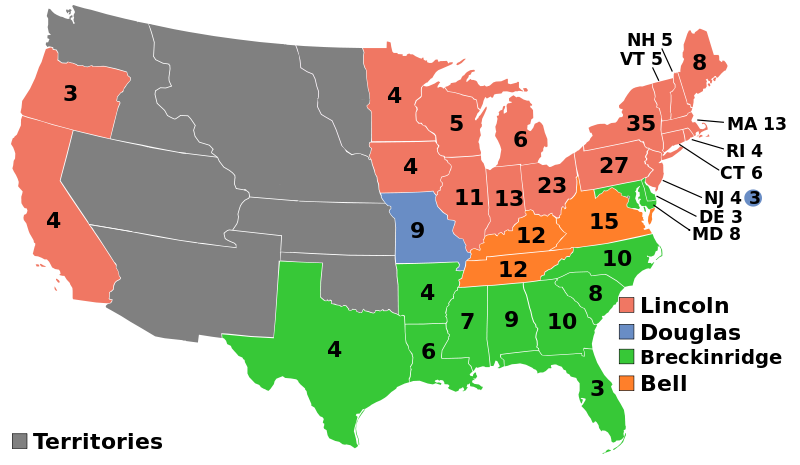
The Democratic Party got incredibly fractured, splitting its voters into four camps: those that went with Republicans, those that opposed slavery but still favored Douglas and his platform, those that liked slavery, and those that just wanted to keep the country together. This isn't to say that Democrats were the only ones not voting Republican, since in the chaotic electoral environment a few minor parties were still around, like Free Soilers, American, Free Silver, etc., but Democrats and Republicans were the two big base factions.
The Democratic Party's convention was the biggest disaster any party has ever seen; there were 57 rounds of balloting, and while Douglas was ahead in every single one by close to 100 votes, he needed a 2/3 majority to win, and most of the delegates from the slave states that bothered to come hated his guts. After those 57 ballots, they decided to try again in a month and a half; this time, the slave state delegates walked out when the convention wouldn't approve a platform plank calling for slavery in all the territories, and with them gone Douglas got the nomination easily. It was a hollow victory, though.
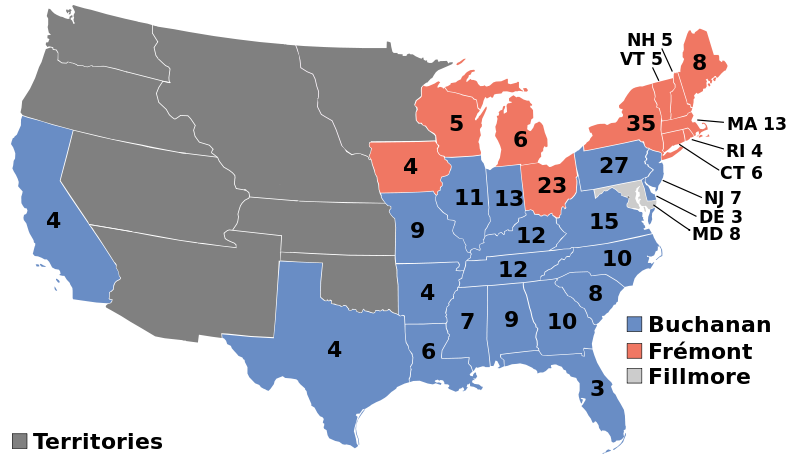
Without the slave states, Fremont would have beaten Buchanan, and Douglas just lost them all.
The slave states had their own convention ten days later, and nominated John Breckinridge, Buchanan's vice president. Breckinridge was virtually certain to win the vast majority of the South, but even if he won the entirety of the region, that wouldn't be enough.
The few who were left, mostly Southern Whigs and anti-immigrants who didn't like Douglas, Lincoln, or Breckinridge, formed the Constitutional Union Party, devoted to "the Union as it is, and the Constitution as it is". An admirable effort to keep the country together, which did decently in the border states, but there were no more compromises palatable to slave states and free states.
As it happens, keeping Lincoln from winning on election night isn't that difficult: if nobody gets a majority of the electoral vote from the College, the top three candidates go to the House. So the task here is to find 29 votes that Lincoln barely won; if he goes down to 151, that's just short of a majority.
Most of those are pretty easy; Lincoln won Illinois' 11 votes with 172,000 votes to Douglas' 160,000. New Jersey had more votes for Democratic electors, but the Southern Democratic faction chose several people for their slate, so the votes got split. Lincoln got 4 votes from that mixup. In Oregon, Lincoln got 5,329 votes against John Breckinridge's 5,075, adding 3 to his total. Lastly, California tossed 4 votes into Lincoln's pile, despite him beating Douglas' 37,999 by 734. Put all those states into the other columns and Lincoln loses 22 votes, still distinctly under the 29 we need.
That's not a huge problem, but it does mean this scenario gets less likely. We've gone from "minor changes in the campaigns" to "several skilled former Whigs decide Douglas has a better plan than Lincoln". However, given the chaos in the electoral system (one major party splits into two pieces, the other is running in its second election), it's still not too implausible.
The next closest state that Lincoln won actually brings us over the top: Indiana had 13 votes at the time, taking Lincoln down to 145 votes. However, he garnered 139,000 votes, beating Douglas' 115,000 by a much larger margin than everything else combined. This isn't too bad: Lincoln's two biggest losses in this scenario are Illinois and Indiana, so having Northern Democrats surge there and Republicans falter is far from an outlandish scenario.
So. Lincoln gets 145 votes, Breckinridge gets 77, Bell gets 51, and Douglas brings up the rear with 40. With this scenario, the House chooses between Lincoln, Breckinridge, and Bell -- the House elected in 1858, with one vote per state. There, Republicans had the majority of the delegations from CT, IN, IA, KS, MA, ME, MI, MN, NH, NJ, NY, OH, PA, RI, TN*, VT, and WI -- seventeen states, just over half the thirty-two then in the Union. However, since NJ, TN, and IN didn't vote for Lincoln in this scenario, they might feel obligated to consider the outcome of the state's vote. The most likely outcome here is still that Republican operatives convince Northern Democrats that Lincoln is a safer bet, and that Douglas cannot keep the South in the Union.
The vice presidency is a different scenario; each Senator gets one vote, and Republicans had only 23 out of 62 seats. Moreover, while the House could pick from the top three candidates, the Senate was limited to only two: Lincoln's running mate, Hannibal Hamlin, and Breckinridge's running mate, Joseph Lane. Here this post becomes almost entirely speculation: the House would likely have chosen first, since Lincoln would already have been close to winning, and his victory likely still would have spurred Southern secession. This would have reduced opposition in the Senate, both from southerners no longer being there to cast a vote against Hamlin, and from northerners fearful of splitting the Union.
But what if Douglas did better still? Lincoln took New York 362,000 to 312,000 for the fusion ticket; had his campaigners turned off the Democrats more, and failed to get out the vote as effectively, its 35 votes would have split 18 to Douglas, 10 to Bell, and 7 to Breckinridge. We now have 110 for Lincoln, 84 for Breckinridge, 61 to Bell, and 58 for Douglas. The most plausible state to change to bring Douglas into the House is Virginia, in which Breckinridge and Bell both got over 74,000 votes, but Bell beat him out by only 156. Giving that to Breckinridge is extremely easy, which puts the totals at 110 for Lincoln, 99 for Breckinridge, 58 for Douglas, and 46 for Bell.
This situation takes a lot of leverage from Republicans, since there's now one more state that can't be counted on to be in their corner, and Lincoln is a lot closer to equaling Breckinridge than doubling him. Still, northern support is needed for any candidate to win, and Douglas has a better claim on it than Breckinridge. In real life, Kentucky Senator John Crittenden offered several Constitutional amendments protecting slavery after Lincoln's victory, in an attempt to preserve national unity. Douglas might have been able to secure Southern delegations with that promise, along with his full support for pro-slavery Joseph Lane of Oregon as vice president.
So there you have it. A slim theoretical scenario for Lincoln's loss, and secession might have been somewhat assuaged. Not fully, of course, but with a much smaller Confederacy, the Civil War could have been shorter and less bloody.
*-Tennessee had 7 out of 10 Opposition members, which at the time was an organization opposing slavery in the West. Grouping them with Republicans here is arguable, but plausible.
Tuesday, May 6, 2014
McCulloch v. Maryland: Federal supremacy and taxation
Banking has always been a hot topic in this country, but in the early days of the republic, the focus was less on Wall Street ruining the economy and getting off scot-free and more on banking services. The financial sector barely existed here at the time, and there was a serious concern that the American dollar would be an unstable currency. Couple that with the general need for someone to make loans, both for ordinary people and for the government, and you had a pretty good case for a bank big enough to take care of all these things, chartered and overseen by the government.
There was a hefty fight to establish it, since it doesn't say in the Constitution that Congress can start a bank, and a whole bunch of people thought it would be helping out people who were already rich a whole lot more than anyone else. Those objections had some validity, but both houses of Congress passed the bill, and the First Bank of the United States came into being in 1791. Unfortunately for the first bank, its charter lasted twenty years, and in 1811 there were a whole lot more people who had those earlier objections, and it took five years to assuage their doubts and begin a Second Bank of the United States.
In 1817, Maryland passed a law taxing any bank that did not first obtain approval from the state government, which, fair enough, the Second Bank of the United States hadn't done before it set up a Baltimore office. James William McCulloch, the head of that branch, refused to pay, particularly since there weren't any other banks hit by the law and there was no justification for the tax, and appealed after the Maryland Supreme Court ruled in favor of the state in 1818.
There were a few issues at stake here.
1. Can Congress create a bank?
2. Are the states the highest authority, since they ratified the Constitution, thereby giving it authority?
3. Can Congress exercise a power not explicitly in the Constitution?
4. Is the Necessary and Proper clause limited to essential government functions, or broader?
Chief Justice John Marshall resolved all four questions in favor of the bank.
Congress created the First Bank of the United States, after a great deal of debate by extremely distinguished legal minds. They didn't find a problem, Marshall said, and therefore history backs a bank.
The states ratified the Constitution through the people of each state, from whom the federal government derives its governing power. Therefore, the people are sovereign, not the state.
Marshall admitted that the Constitution does not explicitly say Congress may establish a bank, but the power was implied by its collective authorities.
The Congress shall have Power ... To make all Laws which shall be necessary and proper for carrying into Execution the foregoing Powers, and all other Powers vested by this Constitution in the Government of the United States, or in any Department or Officer thereof.Marshall contended that the clause would be quite insufficient, and the government hamstrung, if its powers were limited to activities listed in the Constitution and immediate relatives. Any action intended to serve a power of the government and not explicitly prohibited was permitted. Therefore, the state of Maryland was not taxing an unconstitutional institution imposed on its sovereignty by a lower or equal power, and the tax was not constitutional.
Monday, May 5, 2014
Why does Missouri have that little hook into Arkansas?
Initially, it didn't. Missouri's proposed southern border was a straight line at 36°30′, aligned with the boundaries between Kentucky and Tennessee, and Virginia and North Carolina. The eastern border was simply the Mississippi River (which has changed location slightly since 1817), which is a major reason why that notch got cut.

See, in 1811 there was a nasty earthquake on the eastern side of that red region. A lot of the folks there moved away, and a fellow by the name of John Walker bought up a lot of their land (probably for a song). Since it had the St. Francis River on the west and the Mississippi River on the east, irrigating it was about as easy as can be, and pretty soon Walker had a profitable estate.
Then there were rumblings about Missouri getting admitted as a state, and Walker heard about the line putting his land into Arkansas. He wasn't too happy about that, since Missouri had a lot more natural resources, with the rivers to boot. So he went and talked about the land that he owned having closer ties with the Mississippi River towns of Cape Girardeau, Ste. Genevieve and St. Louis in Missouri than with Arkansas, and Congress cut that notch there.
Oh, there's a story about people living in the bootheel who didn't want to live in Arkansas with its bears and panthers and copperhead snakes, and another about a surveyor who was in love with a Missouri widow who lived in the bootheel, but not much evidence for either. Not to say that those couldn't have been true owing to their silliness, because Walker's situation isn't a whole lot more sensible, but there you have it.
Facts herein are from How the States Got Their Shapes, Mark Stein, 2008, published by HarperCollins Publishers.
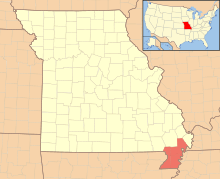
See, in 1811 there was a nasty earthquake on the eastern side of that red region. A lot of the folks there moved away, and a fellow by the name of John Walker bought up a lot of their land (probably for a song). Since it had the St. Francis River on the west and the Mississippi River on the east, irrigating it was about as easy as can be, and pretty soon Walker had a profitable estate.
Then there were rumblings about Missouri getting admitted as a state, and Walker heard about the line putting his land into Arkansas. He wasn't too happy about that, since Missouri had a lot more natural resources, with the rivers to boot. So he went and talked about the land that he owned having closer ties with the Mississippi River towns of Cape Girardeau, Ste. Genevieve and St. Louis in Missouri than with Arkansas, and Congress cut that notch there.
Oh, there's a story about people living in the bootheel who didn't want to live in Arkansas with its bears and panthers and copperhead snakes, and another about a surveyor who was in love with a Missouri widow who lived in the bootheel, but not much evidence for either. Not to say that those couldn't have been true owing to their silliness, because Walker's situation isn't a whole lot more sensible, but there you have it.
Facts herein are from How the States Got Their Shapes, Mark Stein, 2008, published by HarperCollins Publishers.
Saturday, May 3, 2014
Where did the Whigs come from?
Whigs came from opposition -- specifically, opposing Andrew Jackson, after he decisively beat John Quincy Adams in 1828 and easily won reelection in 1832. Jackson stood for the common man, state power, and the power of the executive branch (like most presidents). Adams’ supporters took the name of Whig, since it was often used to describe people who supported the colonies in the Revolutionary War.
The 1824 election itself featured four candidates: Adams, Jackson, Henry Clay, and William Crawford. Jackson got the most electoral votes and popular votes*, garnering 99 of the former and 41% of the latter, but since no one got a majority of the 261 votes then in the College, the election was thrown into the House of Representatives. Since Jackson got the most electoral votes and won the most states, one would think that he would eventually win there, and according to his supporters, the fact that he didn’t was a travesty.
Clay came in fourth, so he wasn’t an option for the House, which was required to pick one of the top three candidates. Since Clay had a lot more common politically with Adams than Jackson, he told his supporters to vote for Adams, who subsequently appointed him Secretary of State. That was later termed the ‘corrupt bargain’, and doubtless was a factor in his 12-point loss four years later.
Initially, Adams’ supporters were simply known as Adams men, and Jackson’s frequently as Jacksonians (they later became known more as Democrats), but soon the former assembled a coalition called the National Republicans, reflecting their focus on national unity and federally financed infrastructure development. National unity was something of a concern still in American politics, since in 1824 the four candidates had won little more than their own regions.

(Adams of Massachusetts, Jackson of Tennessee, Crawford of Georgia, and Clay of Kentucky)
After two successive losses against Jackson, the National Republican Party collapsed, and rebranded itself as the Whigs, with rather more success, electing William Henry Harrison in 1840 and Zachary Taylor in 1848; both died in office.
Friday, May 2, 2014
How did the Whig Party end, anyway?
The Kansas-Nebraska Act in 1854 rang the death knell, though the party was already weak, in part because it was organized poorly and in part because the growing immigrant and Western populations preferred Democrats. Thing is, Whigs opposed slavery, but they also favored a more modern economy, rather than primarily farming, and the development of a strong mercantile sector, which neatly screwed over people who would stay on the bottom rung.
The problem was slavery: the struggle over slave and free states could not be settled permanently, and the time of nation-binding compromises was ending:
1) Three-Fifths Compromise (1787): States paid taxes and were assigned seats in the House of Representatives based on all of their free population and three-fifths of their enslaved population. The South wanted all the slaves to count as people for politics and none of them to count as people for taxes based on population.
2) Missouri Compromise (1820): Maine was admitted as a free state, and Missouri as slave, with slavery banned in states north of 36°30′, Missouri’s southern border.
3) Compromise of 1850: Texas gave up claims on New Mexico and lands north of 36°30′. California was admitted as a single free state despite being right on top of that line. The New Mexico and Utah territories could choose to permit slavery, despite the line running through the former and below the latter. The slave trade was banned in D.C.
The end began innocently enough: plenty of farmland was just waiting to be cultivated in the Great Plains, but settling it required a concerted program to get people in there growing corn and wheat. The railroad companies wanted this more than anybody, since more farmers in the territories meant more freight to get paid to transport. The prime mover was Stephen Douglas: railroad enthusiast, top Senate Democrat, wannabe President (along with nearly every other member of Congress), and fervent believer that each state had the right to decide for itself whether or not to allow slavery.
The Missouri Compromise in 1820 had settled tensions between the North and South until the Mexican-American War, banning slavery in every state north of Missouri’s southern border (36°30′) except Missouri itself and admitting Missouri as a slave state paired with Maine as a free state. The next major deal Congress had to broker to keep everyone from each other’s throats was the Compromise of 1850, the most relevant part in this case being that the New Mexico and Utah Territories, despite being north of Missouri in part or in whole, could decide to allow slavery. That wasn’t going to happen, since desert plantations grow sand and the residents didn’t want slaves anyway, but the principle was established.
To get the Southern support he needed for a railroad, and to promote the principle of popular sovereignty, Douglas proclaimed that Nebraska would allow slavery when admitted to the Union if the residents voted for a state constitution that allowed it. Douglas’s railroad bill ignored the Missouri Compromise rather than outright contravening it, hoping to avoid pissing off supporters, but that wasn’t good enough for Southern Whigs, who wanted to take some of the slave-supporting vote. Senator Dixon of Kentucky added an amendment repealing the 36°30′ line as a boundary against slavery, and Alabama Democrat Philip Phillips did the same in the House.
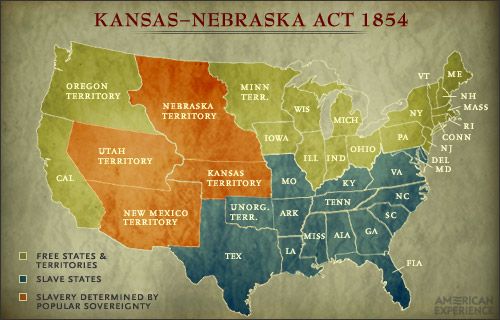
Party leaders, including President Franklin Pierce, decided to make the bill a matter of party loyalty, in part attempting to negate the Whig political move. After four months of debate/arguing among free-staters, popular sovereignty supporters, and slavers, the bill passed both houses. In the Senate, free states split 14-12 in favor, while slave states supported it 23-2. Democrats in the House were of two minds, Southerners backing it 57-2 and northerners again split 44-42 in favor; Whigs were much more mixed, with the northern contingent casting all 45 votes against, but the rest voting 12-7 for. Both parties split on the issue, but the Whigs were more solidly against it; many nay voters joined the infant Republican Party, which had been founded on opposition to slavery.
The Democratic Party became dedicated to the South, while the Republicans dominated the North. The country was becoming starkly divided, and in only six years, that divide would become a bloody reality.
Subscribe to:
Posts (Atom)